I was asked by a young 18yo man a couple of years ago to help him make it possible to discuss the suicide rate because no one believed him when he would post the stat’s…
And he would score TERF pile ons every time he tried to mention it…
Because it’s in the thousands while everyone is screaming loud about a low double figure homicide rate with a budget over a billion
This young man was premier of youth parliament at the time
He asked me for mental health policy
I gave him the mental health cafe concept, it now stands in morwell
And this old MRA is back at it again, I am the eldest daughter of the first victim survivor to openly speak in media in Australia without name suppression, I am working with the trans agenda and the trans lobby
Along with my usual mental health news trying to lift issues of:
- Institutional Abuse
- Juvenile Justice
- Child Maltreatment
- Suicide
- Lack of Sexual Abuse Counselling Access for Men
- Lack of sector recognition of symptoms of trauma and risk of suicide in men
- Predatory Nature of the Reparations Systems
- Factors Driving Domestic Violence
- Criminalisation of Mental Illness
- The true scale of Family and Domestic Violence
- and who the victims are this country so strongly denies
- Homelessness
- Substance Abuse
Epigenetics and childhood trauma
This project used data from the Imaging Genetics in Psychosis study to investigate trauma-related biological changes – including epigenetic (e.g., methylation) markers – shared among schizophrenia and bipolar disorder patients. Gene methylation is a biological process associated with environmental exposures that is known to regulate gene expression. In this study we investigated epigenetic markers and their relationship to diagnostic status, cognitive performance, brain phenotypes and genetic vulnerability for schizophrenia and bipolar disorder.
This project received funding from the National Health and Medical Research Council (Project APP1081603; 2015 – 2017).
Completed PhD students: Dr Oliver Watkeys, Dr Nina Teroganova.
External collaborators: Murray Cairns (Newcastle), Sarah Cohen-Woods (Adelaide), Naomi Wray (UQ)

As per usual the moment we start getting reforms on the ground those behind the dashboards mess with them to hide the raw numbers, this has always been a constant fight against the academics within these government institutions to lift these issues, they go out of their way to make it difficult, this will to some degree be a link dump, I have broca’s aphasia following strokes in 2022
Suicide
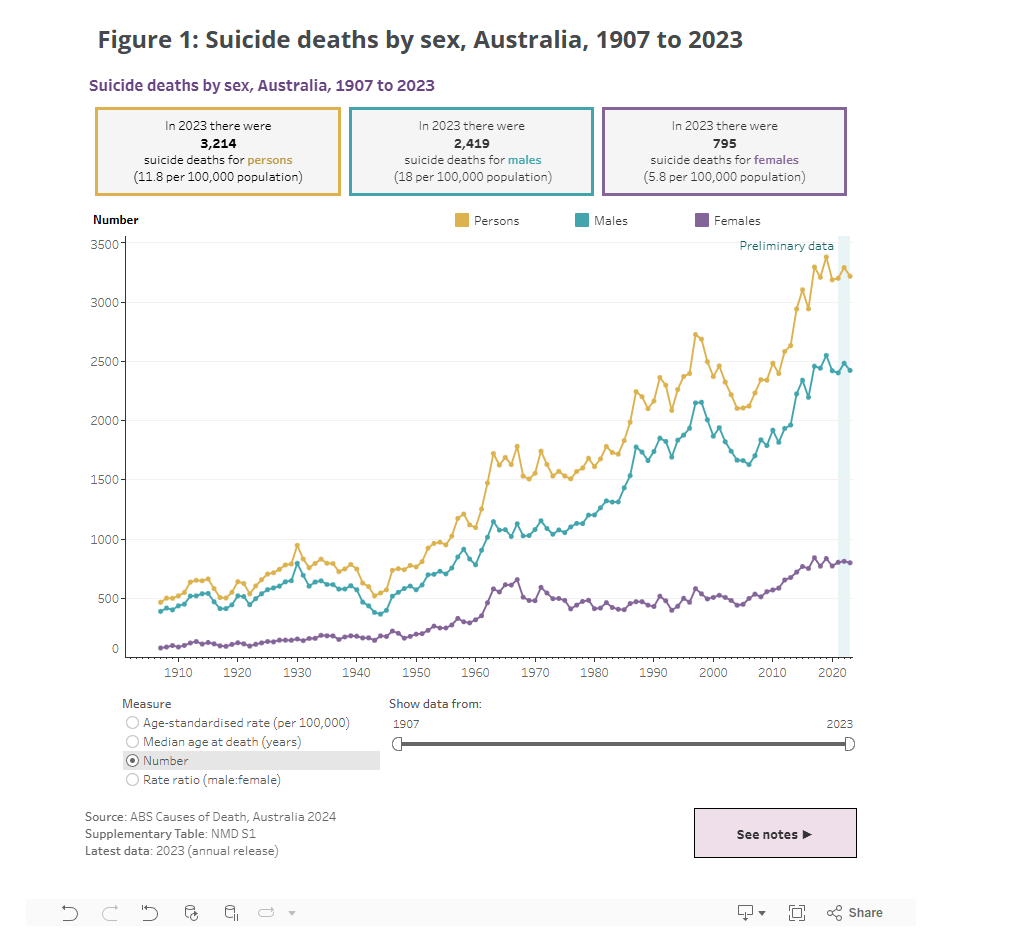
In 2023, there was 2,419 deaths by suicide for males and 795 deaths by suicide for females.
Australian Institute of Health and Welfare
The age distribution of deaths by suicide is similar for males and females, and the highest proportion of deaths by suicide occur during mid-life. More than half of all deaths by suicide (54.9%) in 2023 occurred in people aged 30–59 years (1,765 deaths). A further 23.4% of suicide deaths occurred in people aged 60 years and over (752 deaths) and 20.8% occurred in people aged 15–29 years (670 deaths). Suicide was the leading cause of death among people aged 15–44 years in 2023 (ABS 2024).
Age-specific suicide rates for males are higher than those for females across all reported age groups for all years (Figure 2).The highest suicide rate for males in 2023 occurred in those aged 55–59 years (30.9 deaths per 100,000 population). This is followed by males aged 45–49 years (27.3), and males aged 40–44 years (27.2). The highest suicide rate for females was among those aged 50–54 years (10.0 deaths per 100,000 population), and the lowest was for females aged 80–84 years (3.8).
1960, post WWII work was underway looking at the social determinants or morbidity, looking at ways to reduce rates of homicide, suicide and else, in australia in the 1990’s and into the 2000’s was forensic psychology research headed by Freda Briggs being produced and producing reforms across justice and social welfare services to reduce rates of child sexual assault. In 2005 we directly handed those research papers to parliament to support family law policy, “Shared Parental Responsibility” to increase risk of detection and mitigate rates of. 2003 Michael Flood introduced the term “Toxic Masculinity” to the UN. Toxic Masculinity by his statements is actually Hegemonic Masculinity, indications of trauma in Men. Yes the term Toxic Masculinity was literally crafted to blame men for their own symptoms of Trauma
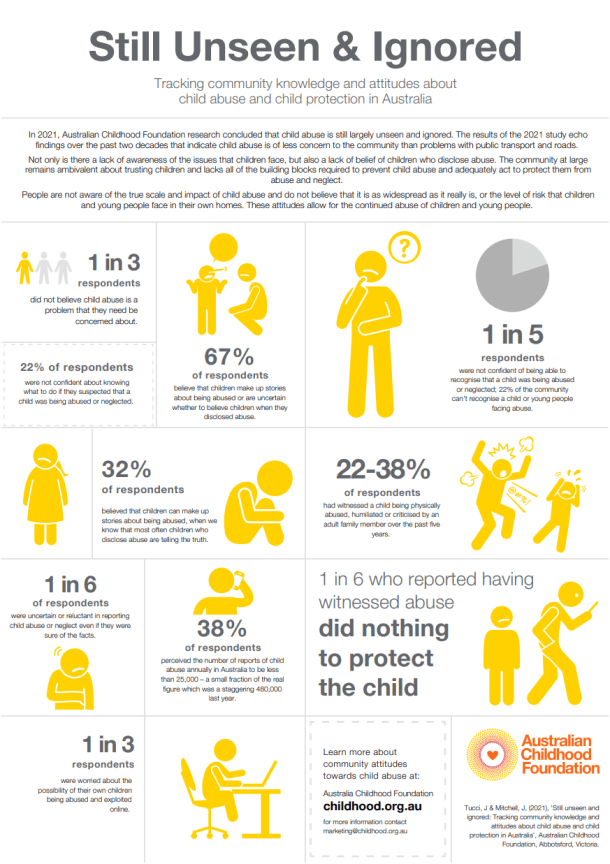
Child Maltreatment
In 2023 the Australian Child Maltreatment Study Informs us:
Parental separation, family mental illness, family substance problems and family economic hardship DOUBLE the risk of multi-type maltreatment.
Children who experience multi-type maltreatment are more likely to have a mental disorder and health risk behaviours as adults.
Children who experience maltreatment are more likely to have a mental health disorders in adulthood.
Child maltreatment dramatically increases the likelihood of three serious health risk behaviours: cannabis dependence, self-harm, and suicide attempt.
Associated harm continues over life.
By middle age (45 years plus) cannabis dependence, self-harm, and suicide attempts) were too rare to be detected in mature aged Australians (45+ years) who had not experienced CM.
Child maltreatment increases the odds of all health risk behaviours.
Young people who experienced child maltreatment were no more likely to engage in binge drinking than other young people.
Experiencing 3 or more types of maltreatment is associated with the greatest impact on health service utilisation.
This health service use appears to be driven by mental health impacts. Child maltreatment was not related to increased past year hospitalisations for physical health.Young people who experienced child maltreatment are:
- 2x more likely to be a current smoker
Child maltreatment 19.8% v 8.4%
- 5x more likely to be dependent on cannabis
Child maltreatment 5.9% v .6%
- More likely to have obesity
13.6% vs 8%
- 4.6x more likely to have self-harmed in past 12 months
5.2% versus 0.6%
Who are the Perpetrators of Child Maltreatment?
Differences and similarities between mothers’ and fathers’ risk factors for child maltreatment
Child Maltreatment 2019
USA report This report presents national data about child abuse and neglect known to child protective services agencies in the United States during federal fiscal year 2019.
Sexual abuse of boys often overlooked by state laws, global study warns
Children talking to ChildLine about Sexual Abuse
The Sexual Victimization of Men in America: New Data Challenge Old Assumptions

Systemic Failures
Beyond the Emergency Project
2015-16 Coded Ambulance Data
- More than 110,000 ambulance attendances for males experiencing acute mental health issues
- 78% were transported to hospital
- Self-harm ambulance data indicates rates three times higher than available hospitalisation data
- More than 60% of attendances occurred after hours
- 42% of attendances were to men re-presenting to ambulance services
- More than 30% of attendances involved police
Paramedic experiences
<1 in 3 felt highly confident in responding to people experiencing mental health issues
< 14 % reported comprehensive training for mental health responses
Only a small fraction of people with mental health or substance-use disorders receive effective care
They found:
- Only 46.5 per cent of people who met the criteria for a disorder recognized their need for treatment.
- Of those who did recognize their need, only 34.1 per cent turned to the medical system for help.
- Most who sought help (82.9 percent) received a minimum level of adequate treatment.
- About 47 per cent of people who received minimally adequate treatment ended up receiving effective treatment.
Attrition at various points along this pathway meant that only 6.9 per cent ended up receiving effective treatment.
“Understanding where the bottlenecks are for each of these disorders provides a unique and previously unavailable blueprint for decision makers to understand problems objectively and try to adjust the system,” said Dr. Vigo.
The study revealed a significant drop-off after patients contacted the healthcare system but before they received effective treatment. Since general practitioners and family doctors are typically their first point of contact with the system, it’s essential to make sure those doctors have appropriate training, said Dr. Vigo.
“Improving the ability of these general practitioners and family doctors to diagnose and treat the mild to moderate forms, and to know when to refer more severely affected folks to specialists, becomes the cornerstone of the system,” he said.
Exclusive: Health authority suppressed gendered violence research
Flawed cashless welfare cards rebadged
Boys and men who experience childhood sexual abuse are being left behind
What Too Many People Get Wrong About Men
Money for trauma
As survivors try to reconcile a history of traumatic institutional abuse, a circling pack of law firms seeks to profit from their pain.
How to make a killer
It started with a train ride and ended in a murder. Now an ABC investigation reveals the failings that helped create one of Queensland’s youngest killers.
Crossover out-of-home care into detention
The link between child maltreatment and adolescent offending
Locking up young people might make you feel safer but it doesn’t work, now or in the long term
‘We don’t have a cultural place for men as victims’: why men often don’t tell anyone about sexual abuse
Meta’s shift to ‘community notes’ risks hurting online health info providers more than ever
State systems are hurting kids, but the Commonwealth can protect them
Prisons don’t create safer communities, so why is Australia spending billions on building them?
What if there was no youth crime?
Why societies must protect children if they want fewer criminals
Diverting children away from the criminal justice system gives them a chance to ‘grow out’ of crime
Diverting children away from the criminal justice system gives them a chance to ‘grow out’ of crime
Unlawful violence restraining order served on Perth boy, 7, by mistake
Homelessness
Homeless Australians are dying at age 44 on average in hidden crisis
Guardian Australia investigation lifts the veil on shocking life expectancy gap and the system failures fuelling deaths
Every four days a young homeless person dies. Advocates are calling for urgent reform
In short:
Young people face high rates of homelessness and mental ill-health.
Advocates say the cost of private rentals and mental health care are causing more and more young people to fall through the gaps.
What’s next?
A new report says barriers to mental health care, such as difficulty in accessing early interventions, should be addressed urgently.
Juvenile Justice, Criminalisation and Deaths in Custody
Prison for kids
A “gladiator pit”, a “war zone”, a “kindergarten for the adult prison” — these are just some of the ways Tasmania’s only youth detention centre has been described.
This is what it’s like inside.
Images and video of young people in this story are recreations.
Youth detention centre’s damaging legacy
A 7.30 investigation into one youth detention centre has uncovered a shocking abuse of power by some staff against the teenage detainees they were meant to care for.
Starved in Jail
Why are incarcerated people dying from lack of food or water, even as private companies are paid millions for their care?
The rotten core
A Tasmanian inquiry uncovered decades of catastrophic failure to protect young people in the state’s care and a bureaucratic tangle that sheltered their abusers
Female Child Sex Offenders, Australia’s Blind Spot
Disturbing Findings on the Sexual Victimization of Men with Mental Illness
Sexual victimization perpetrated by women: Federal data reveal surprising prevalence
Child sexual abuse by women is on the rise. We don’t have the support services to cope
Uncovering Female Child Sexual Offenders—Needs and Challenges for Practice and Research
Female sex offenders: What exclusionary feminism ignores
Understanding Girls Who Commit Sexual Offenses
Female child sex abuse ‘remains taboo’ while victims struggle
Woman as Molester; Implications for Society
A decade-long study reveals concerning trend of young women committing online sexual offences
Why It’s So Hard to Recognize Maternal Sexual Abuse
Sons sure a mother wouldn’t harm them, and mothers who take advantage.
Life-long trauma: When mothers sexually abuse their sons
New research shedding light on sex abuse committed by mothers against their sons
SFF community reeling after Marion Zimmer Bradley’s daughter accuses her of abuse
Sexual offending runs in families: A 37-year nationwide study
Not for viewing by Children
Domestic Violence
Sleep and Interpersonal Violence: A Systematic Review
Statistics on Male Victims of Domestic Abuse – Mankind
What can we learn from Domestic Homicide Reviews with male victims?
Reciprocal pathways between intimate partner violence and sleep in men and women
Domestic violence is most commonly reciprocal
Women as Active Agents: Female Perpetrators of Sexual Harassment and Domestic Abuse
The Victim–Offender Overlap in Intimate Partner Violence: A Within-Individual Approach
Erin Pizzey Founder of Refuge
‘Domestic violence can’t be a gender issue’
Erin Pizzey: The Story of the Feminist Who Was Threatened for Acknowledging Male Victims
Erin Pizzey: The woman who looked beyond the bruises

 The Little Super Hero
You must be logged in to post a comment.